
More than 60 percent of American eCommerce sites lose sales due to slow load times and confusing checkout processes. For seasoned online business owners, the challenge is clear navigating tough competition while making every visitor count. This guide walks through proven steps to transform your website using data analysis, automated marketing, and focused design—helping you increase conversions and create lasting growth.
Table of Contents
- Step 1: Audit Current Site Performance And Analytics
- Step 2: Identify Key Conversion Opportunities
- Step 3: Implement Strategic Design Enhancements
- Step 4: Automate Lead Capture And Marketing Funnels
- Step 5: Test Updates And Analyze Conversion Results
Quick Summary
| Key Insight | Explanation |
|---|---|
| 1. Audit Site Performance | Analyze analytics to identify user behavior and site performance issues. Focus on bounce rates, conversion rates, and user flows. |
| 2. Identify Conversion Opportunities | Find high-traffic pages with low conversion rates and optimize them for better sales performance. Use market research for insights. |
| 3. Implement Design Enhancements | Simplify navigation and optimize user experience to guide customers more effectively toward purchases. Use clear visuals and trust signals. |
| 4. Automate Marketing Efforts | Utilize automation tools to capture leads and nurture them through targeted email campaigns to increase conversions. |
| 5. Test Changes and Analyze Results | Continuously A/B test changes on your site to measure effectiveness, using statistical data to inform your strategies and improvements. |
Step 1: Audit Current Site Performance and Analytics
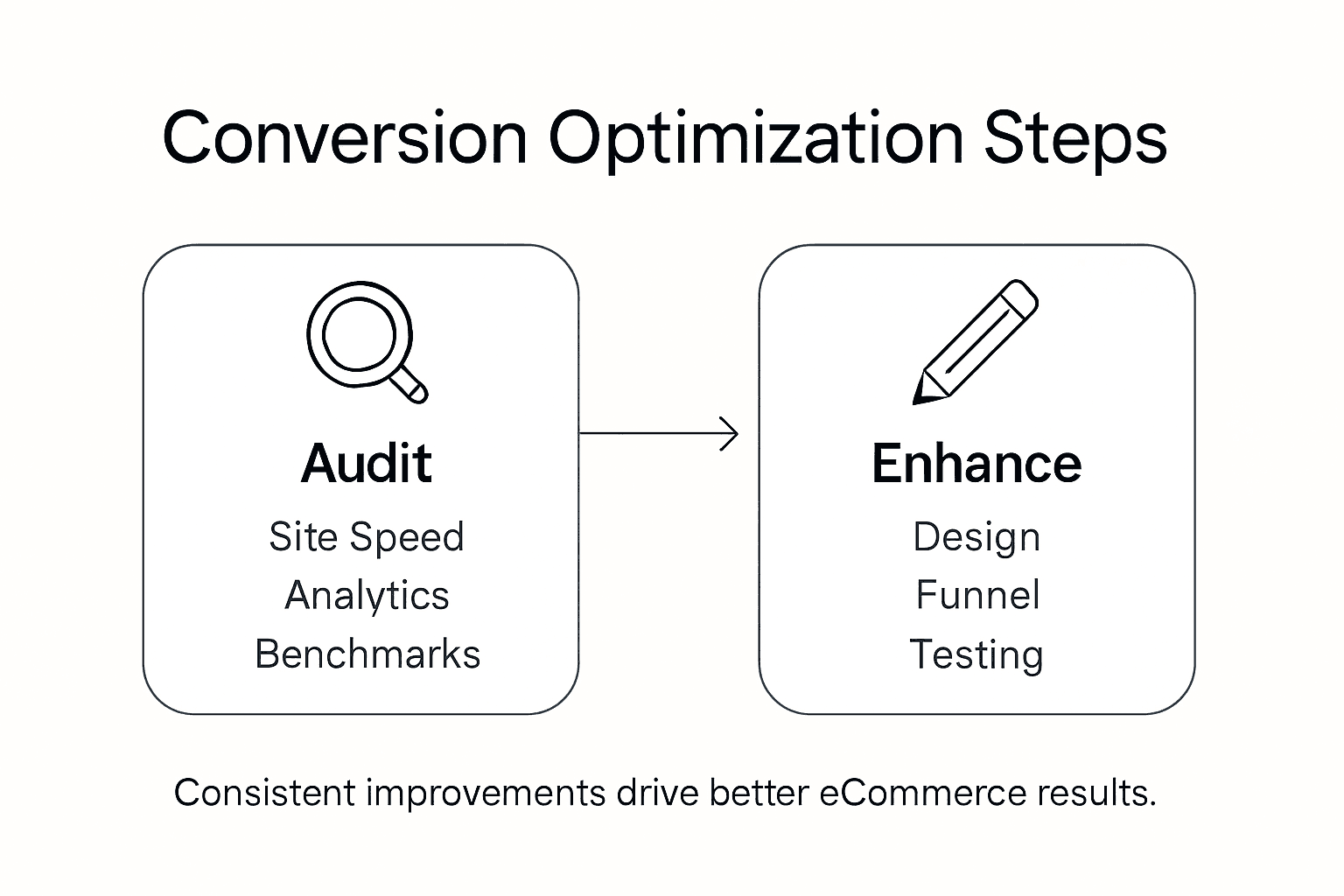
Auditing your eCommerce website’s performance and analytics is a critical first step in optimizing conversions. This process helps you understand how users interact with your site, identify potential roadblocks, and make data-driven improvements that directly impact your bottom line.
To conduct a comprehensive site performance audit, start by diving deep into your website’s data-driven analytics platforms to review all digital transactions and site metrics. Focus on key performance indicators such as bounce rate, average time on page, conversion rate, and user flow. Use tools like Google Analytics to track these metrics, paying special attention to pages with high exit rates or low engagement. Analyze user behavior patterns to understand where potential customers might be dropping off in your sales funnel.
Compare your site’s performance against industry benchmarks and look for specific areas of improvement. This might include page load speed, mobile responsiveness, checkout process complexity, and overall user experience. Utilize heat mapping tools to visualize where users click, scroll, and spend the most time on your site. Cross-reference these insights with conversion data to identify specific design or functionality elements that might be hindering your sales potential.
Pro tip: Set up custom dashboards in your analytics platform that highlight your most critical conversion metrics, allowing you to quickly monitor and respond to performance changes in real time.
Here is a comparison of common eCommerce performance metrics and their impact on conversion optimization:
| Metric | What It Measures | Business Impact |
|---|---|---|
| Bounce Rate | % visitors leaving after one page | Indicates poor engagement or relevance |
| Conversion Rate | % visitors completing a purchase | Directly affects revenue growth |
| Page Load Speed | Time to fully display site | Slow speed can increase abandonment |
| Cart Abandonment Rate | % carts not completed | Highlights checkout or pricing issues |
| Average Order Value | Revenue per transaction | Impacts profitability and upsell |
| Mobile Responsiveness | Site usability on mobile devices | Enhances accessibility and reach |
Step 2: Identify Key Conversion Opportunities
Identifying key conversion opportunities requires a strategic approach to understanding how your eCommerce website can transform casual browsers into committed customers. This step involves deep analysis of your current performance and potential growth areas that can significantly improve your sales funnel.
Begin by examining comprehensive eCommerce market research that highlights emerging trends and consumer behavior patterns. Analyze your current website traffic and segment your audience based on demographics, purchasing behavior, and engagement levels. Look for specific pages or product categories with high traffic but low conversion rates these are prime opportunities for optimization. Study your website analytics to understand user journeys map out where potential customers drop off and identify friction points in the purchasing process.
Utilize benchmark data from U.S. Census Bureau e-commerce statistics to compare your performance against industry standards. This will help you pinpoint specific areas where your conversion strategy might be underperforming. Pay close attention to metrics like average order value, cart abandonment rates, and customer lifetime value. Consider implementing targeted strategies such as personalized product recommendations, simplified checkout processes, or dynamic pricing to address potential conversion barriers.
Pro tip: Create a conversion opportunity matrix that ranks potential improvements by estimated impact and ease of implementation, allowing you to prioritize the most effective optimization strategies.
Step 3: Implement Strategic Design Enhancements
Implementing strategic design enhancements is about transforming your website from a simple online storefront into a powerful conversion engine that intuitively guides customers toward making a purchase. This critical step involves carefully crafting a user experience that eliminates barriers and creates a smooth, engaging path to conversion.
Begin by applying design-led strategic approaches that focus on user-centric website architecture. Analyze your current site layout and identify potential friction points in the user journey. This means examining every element from navigation menus to product pages with a critical eye toward simplifying the user experience. Implement clear visual hierarchies that draw attention to key conversion elements like call-to-action buttons, reduce unnecessary clicks, and create intuitive pathways that guide users naturally toward making a purchase.

Leverage insights from marketing research and academic design studies to make data-driven design decisions. This might include optimizing color schemes to evoke specific emotional responses, strategically placing trust signals like security badges and customer reviews, and creating responsive design elements that adapt seamlessly across different devices. Pay special attention to your checkout process streamline form fields, offer multiple payment options, and minimize distractions that could cause potential customers to abandon their purchase.
Pro tip: Conduct regular A B testing on design elements to continuously refine your website’s conversion potential, treating your site as a living platform that evolves with user feedback and behavior.
Below is a summary of strategic design enhancements and their expected outcomes:
| Design Enhancement | Action Taken | Expected Outcome |
|---|---|---|
| Simplified Navigation | Streamline menus and user flow | Reduces friction, improves conversion |
| Visual Hierarchy | Highlight CTAs and key elements | Directs user attention, boosts engagement |
| Trust Signals | Add reviews and security badges | Increases user confidence to purchase |
| Responsive Design | Optimize for all device types | Expands reach, lowers abandonment |
| Checkout Optimization | Minimize form fields and distractions | Improves completion rate, faster buying |
Step 4: Automate Lead Capture and Marketing Funnels
Automating lead capture and marketing funnels transforms your eCommerce strategy from manual outreach to a sophisticated system that consistently attracts, nurtures, and converts potential customers. This step is about creating an intelligent digital infrastructure that works tirelessly to grow your business even when you are not actively managing every interaction.
Implement comprehensive digital transformation strategies to streamline your lead generation process. Leverage marketing automation tools that integrate with your website to capture visitor information through strategic pop-ups, exit intent forms, and interactive content. Design multiple lead magnets that provide value to different customer segments such as downloadable guides, exclusive discounts, or personalized quizzes. Configure automated email sequences that segment leads based on their interactions and deliver targeted content that progressively moves them through your sales funnel.
Deploy advanced automation techniques that support cross-border eCommerce engagement by creating personalized customer journeys. Use behavioral triggers that automatically send follow up communications based on specific user actions like abandoned cart recovery emails, recommended product suggestions, and re-engagement campaigns. Integrate customer relationship management systems that track interactions across multiple touchpoints enabling you to create increasingly sophisticated and responsive marketing workflows that adapt to individual customer behaviors.
Pro tip: Regularly audit your automation workflows every 90 days to ensure they remain responsive to changing customer behaviors and continuously optimize your conversion pathways.
Step 5: Test Updates and Analyze Conversion Results
Testing updates and analyzing conversion results is the critical final stage that transforms your optimization efforts from guesswork into a precise, data-driven strategy. This step ensures that every change you implement is measurably improving your eCommerce performance and generating tangible business results.
Begin by implementing comprehensive digital measurement methodologies that go beyond surface-level metrics. Set up robust A/B testing protocols that compare different design elements, messaging variations, and user experience modifications. Create controlled experiments where you test one variable at a time such as button colors, headline text, product page layouts, or checkout process steps. Collect statistically significant data by running tests long enough to generate meaningful insights while ensuring you have a large enough sample size to draw accurate conclusions.
Utilize official eCommerce benchmarking data to contextualize your results and understand how your performance compares to broader industry standards. Track key performance indicators like conversion rate, average order value, cart abandonment rate, and customer acquisition cost. Create detailed dashboards that visualize your testing results, allowing you to quickly identify which changes drive positive outcomes. Pay close attention to segment specific insights such as differences in performance across device types, customer demographics, or traffic sources to develop a nuanced understanding of your optimization efforts.
Pro tip: Implement a continuous improvement cycle where you allocate at least 20% of your optimization budget to ongoing testing and refinement, treating your website as an evolving platform that constantly adapts to changing customer behaviors.
Unlock eCommerce Growth with Strategy-Driven Solutions
Struggling to turn website visitors into loyal customers is a common challenge highlighted in “How to Optimize Website Conversions for eCommerce Success.” This article focuses on overcoming key pain points such as high bounce rates, cart abandonment, and complex checkout processes by implementing data-driven audits, strategic design enhancements, and automated marketing funnels. If you want to transform your online store into a high-converting, revenue-generating platform you need a partner who blends creativity and technology to deliver measurable results.
At Lind Creative, we specialize in building powerful, conversion-focused websites backed by our signature Growth Engine system. We help businesses attract the right traffic, capture leads automatically, and nurture customers through personalized marketing efforts. Explore our Web Design – Lind Creative services to create intuitive user journeys that reduce friction. Dive into Digital Marketing – Lind Creative to automate campaigns that drive engagement and sales. Start your transformation today by visiting our main website to see how we can help your eCommerce business scale effectively.

Ready to stop guessing and start converting? Connect with Lind Creative now to unlock your website’s true potential and drive real ROI with strategy-driven design and marketing that works for you.
Frequently Asked Questions
How can I improve my website’s conversion rate?
To improve your website’s conversion rate, start by auditing your current site performance and user analytics. Identify key metrics like bounce rate and average order value, and implement targeted changes such as optimizing your checkout process or enhancing product pages to reduce abandonment rates.
What are the essential conversion metrics to monitor for eCommerce success?
The essential conversion metrics to monitor include conversion rate, average order value, cart abandonment rate, and page load speed. Track these metrics regularly to identify areas for improvement and make timely adjustments that can lead to increased sales.
How do I identify conversion opportunities on my eCommerce site?
Identify conversion opportunities by analyzing traffic data and user behavior patterns on your site. Focus on pages with high traffic but low conversion rates, and prioritize optimization strategies such as simplifying navigation or offering personalized recommendations to enhance user experience.
What design enhancements can help optimize my eCommerce site?
Implement design enhancements like streamlined navigation, clear visual hierarchies, and trust signals to boost conversions on your eCommerce site. Start by simplifying your site layout, which can reduce friction and lead to a smoother purchasing process for users.
How can I effectively test updates made to my website?
To effectively test updates made to your website, set up A/B testing protocols that compare different design elements one at a time. Run tests long enough to gather meaningful data and analyze the results to determine which changes significantly improve conversion rates, adjusting your approach as needed.
What is the role of automation in eCommerce marketing funnels?
Automation plays a crucial role in streamlining lead capture and nurturing potential customers through your marketing funnel. Use marketing automation tools to create targeted email sequences and follow-up communications based on user interactions, which can enhance your overall conversion strategy.
Recommended
- 7 Essential Ecommerce Website Design Tips for Growth – Lind Creative
- Defining High-Converting Websites for Results-Driven Growth – Lind Creative
- Complete Guide to Website Optimization Strategies – Lind Creative
- 7 Essential Website Design Tips for Business Growth Success – Lind Creative
- Maximize Conversions: E-Commerce Optimization Tips